1. Introduction: The Critical Decision Facing Modern Digital Brands
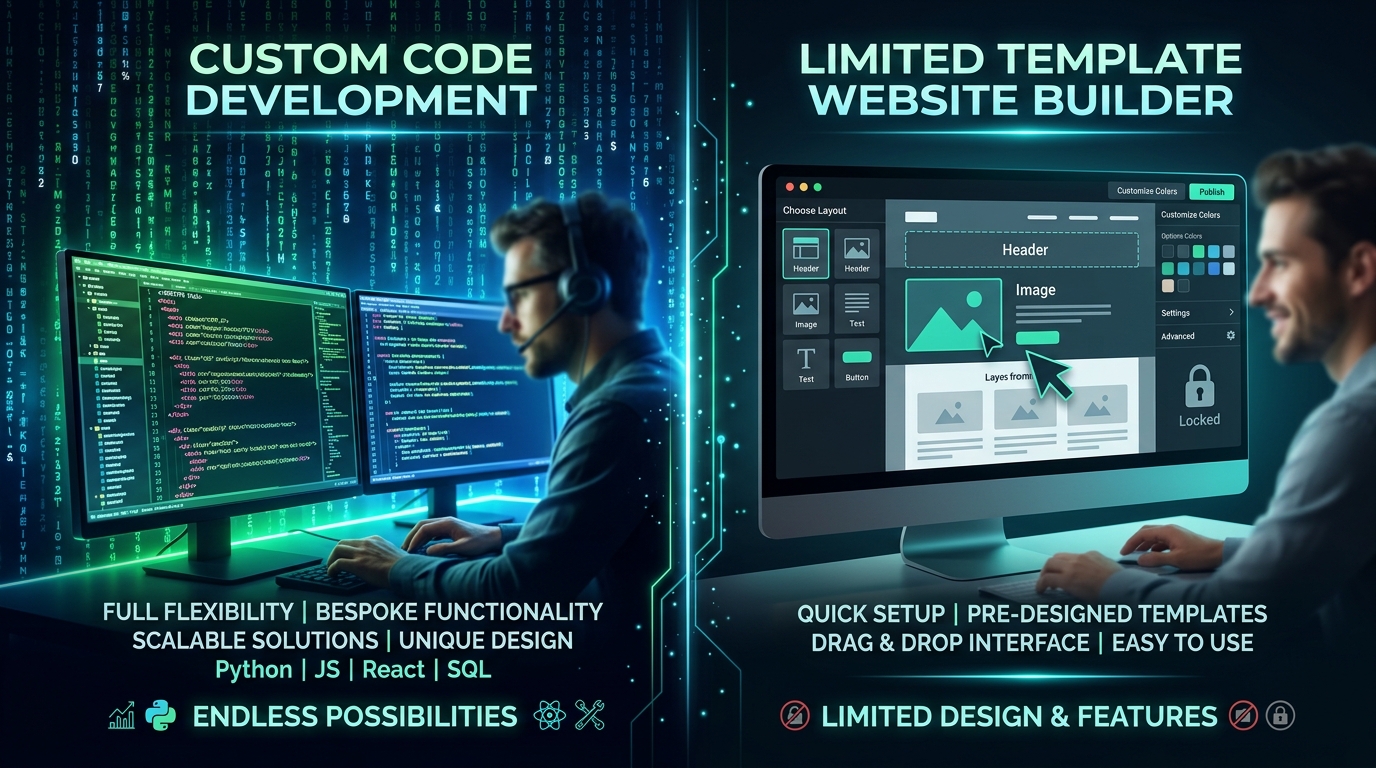
When launching or upgrading an online platform, business leaders face a pivotal technical decision: rely on a template drag-and-drop website builder (such as Wix, Squarespace, or generic WordPress site builders) or invest in bespoke custom web engineering built on modern frameworks like React and Next.js.
While template site builders promise visual instant setups and low upfront entry costs, growing enterprises quickly hit rigid performance ceilings. Sluggish page load times, unresolvable technical SEO limitations, severe security vulnerabilities from third-party plugins, and total vendor lock-in quickly degrade conversion rates and damage organic search engine visibility.
Investing in professional custom web design and development delivers a fully owned, high-concurrency web asset engineered specifically around brand identity, business workflows, and revenue targets.
2. Code Bloat & Core Web Vitals: Custom Engineering vs. Template Builders
Google evaluates site user experience using strictly enforced Core Web Vitals (Largest Contentful Paint, Interaction to Next Paint, Cumulative Layout Shift). Page velocity directly influences Google search rankings and ad cost-per-click efficiency.
Why Drag-and-Drop Builders Suffer Severe Speed Degradation
Drag-and-drop site builders must cater to millions of non-technical users building vastly different page layouts. To accommodate every conceivable visual style, builders ship heavy universal CSS libraries, bloated JavaScript layout engines, dynamic WYSIWYG runtime scripts, and redundant inline styles into every single page request. Even a simple 3-paragraph landing page rendered via a site builder frequently downloads between 3MB to 8MB of uncompressed assets and executes thousands of milliseconds of render-blocking main thread JavaScript.
The Custom Next.js Clean Code Architecture
Bespoke custom web application development compiles only the exact HTML code, CSS rules, and React component state required for that specific page view. By leveraging Next.js server components, tree-shaking dead code, inline font optimization, and modern AVIF/WebP image pipelines, custom platforms ship lightweight page bundles under 300KB.
Real-World Speed Impact on Conversions
Research across millions of e-commerce user sessions demonstrates that every 100-millisecond delay in page load time reduces visitor conversion rates by 7%. Custom Next.js web applications achieving sub-500ms global response times routinely outperform template builder competitors by 30% to 50% in lead form completions.
3. Technical SEO Freedom: Server Control vs. Walled Gardens
Organic search engine optimization requires granular control over backend server architecture, crawl budget allocation, and semantic structured data. Website builders operate as strict "walled gardens," locking administrators out of critical technical configuration files.
Restrictions Imposed by Website Builders
- Rigid URL Routing & Trailing Slashes: Inability to eliminate duplicate page penalty parameters or enforce strict 301 server redirects.
- Truncated Schema Options: Restricted to basic Schema.org types, making it impossible to inject custom nested JSON-LD entity structures for complex services.
- Blocked Server Headers: Inability to modify HTTP response headers, CSP security headers, or custom edge caching rules.
- AI Crawler Access Denial: Lack of granular control over
robots.txtfile permissions to grant or restrict specific AI discovery bots (such as GPTBot and PerplexityBot).
Unrestricted Optimization with Custom Engineering
Custom software development grants 100% control over server routing tables, dynamic XML sitemap generation, structured schema markup, and custom metadata pipelines. Leveraging advanced technical SEO performance optimization allows businesses to adapt instantly to major Google algorithm updates without waiting for template vendor feature rollouts.
4. Security Shielding: Zero Plugin Dependencies vs. Exploit Risks
Website builders and legacy CMS platforms rely heavily on third-party marketplace plugins to extend basic functionality (such as contact forms, SEO meta fields, image galleries, and popups). Every added plugin represents an unvetted third-party codebase running on your server.
According to global cybersecurity benchmarks, over 90% of CMS website hacks occur through outdated or vulnerable third-party plugins rather than core platform flaws. When a plugin author abandons security updates, malicious actors exploit SQL injection, cross-site scripting (XSS), and backdoor vectors to inject spam links or compromise customer databases.
Custom serverless architectures built on Next.js compile down to static HTML assets and immutable serverless edge functions. With zero third-party plugin dependencies, the public attack surface is virtually eliminated. Businesses requiring continuous enterprise-grade security benefit from proactive website maintenance to enforce zero-downtime deployment pipelines.
5. Scalability, Custom Logic & Enterprise API Integrations
As businesses expand, workflow demands become more sophisticated. You may need to integrate custom ERP inventory systems, multi-tiered CRM pipelines, dynamic customer portals, proprietary price calculators, or international multi-currency checkout gateways.
Drag-and-drop builders force businesses to fit into pre-built template boxes. If a feature does not exist within the builder marketplace, business operations stall or require clunky iframe embeds that ruin mobile user experience.
Modern full-stack custom web application development provides infinite architectural flexibility. Developers can design custom REST or GraphQL API endpoints, connect relational databases (PostgreSQL, MySQL, MongoDB), and implement complex business logic without performance overhead.
6. Comprehensive Technical Comparison Matrix
Here is a detailed comparison breaking down the differences between custom Next.js engineering and template website builders across key operational metrics:
| Feature Category | Custom Web Development (Next.js) | Template Website Builders (Wix/WordPress) |
|---|---|---|
| Google PageSpeed Score | 95 - 100 Mobile & Desktop | 35 - 65 (Degraded by script bloat) |
| Average Load Time | < 500ms Global CDN Delivery | 3.0s - 6.0s (High bounce rate) |
| Code & Asset Ownership | 100% Owned Source Code Asset | Locked in Proprietary Vendor Cloud |
| Security Vulnerability | Serverless Architecture (Zero Plugins) | High Risk (Plugin exploit vectors) |
| Custom API & Database Integration | Unlimited Native Rest/GraphQL/SQL | Restricted to App Marketplace Plugins |
| Technical SEO Control | Full Access to Headers, Schemas & Routing | Restricted Meta Fields & Walled Gardens |
7. Total Cost of Ownership (TCO) and Long-Term ROI Analysis
At first glance, website builders appear significantly cheaper due to low monthly subscription fees ($20 to $50/month). However, growing companies quickly accumulate hidden cost escalation:
- Monthly Plugin Subscription Stacks: Individual monthly fees for SEO plugins, form builders, security scanners, multi-language tools, and cart plugins easily add up to $300 - $800/month.
- Lost Revenue from Slow Page Speeds: Higher bounce rates and lower search rankings translate directly into lost leads and reduced customer acquisition ROI.
- Costly Re-Platforming Obstacles: When your company outgrows a website builder, migrating content out of proprietary template databases often requires a complete rebuild from scratch.
Investing upfront in custom web development creates a permanent proprietary software asset. You pay no recurring plugin tax, retain complete hosting freedom across any server provider, and benefit from superior organic acquisition conversion rates for years to come.
8. Strategic Migration: Transitioning from Builders to Custom Code
If your organization is currently constrained by a slow, rigid website builder, migrating to a custom Next.js stack can be executed seamlessly without losing current search engine authority:
- Content & Route Mapping: Audit all existing URL structures to construct a comprehensive 1:1 301 redirect map.
- Design & UX Modernization: Upgrade outdated layout templates into responsive, accessible UI components.
- Schema & Metadata Migration: Extract and expand structural schema markups to enhance Google rich snippet presence.
- Parallel Edge Testing: Validate page rendering speeds and form submission pipelines on staging environments before final DNS cutover.
9. Conclusion: Future-Proofing Your Digital Presence
In 2026 and beyond, generic template websites are no longer sufficient to win against agile, fast-moving digital competitors. Drag-and-drop site builders serve a purpose for hobbyists and temporary MVP validation, but serious digital brands require the velocity, security, search engine dominance, and architectural freedom of custom web engineering.
Exploring real-world custom web platforms across web development portfolio case studies demonstrates the transformative impact of custom code architecture.
Organizations planning to build high-performance web assets can initiate a web development consultation.