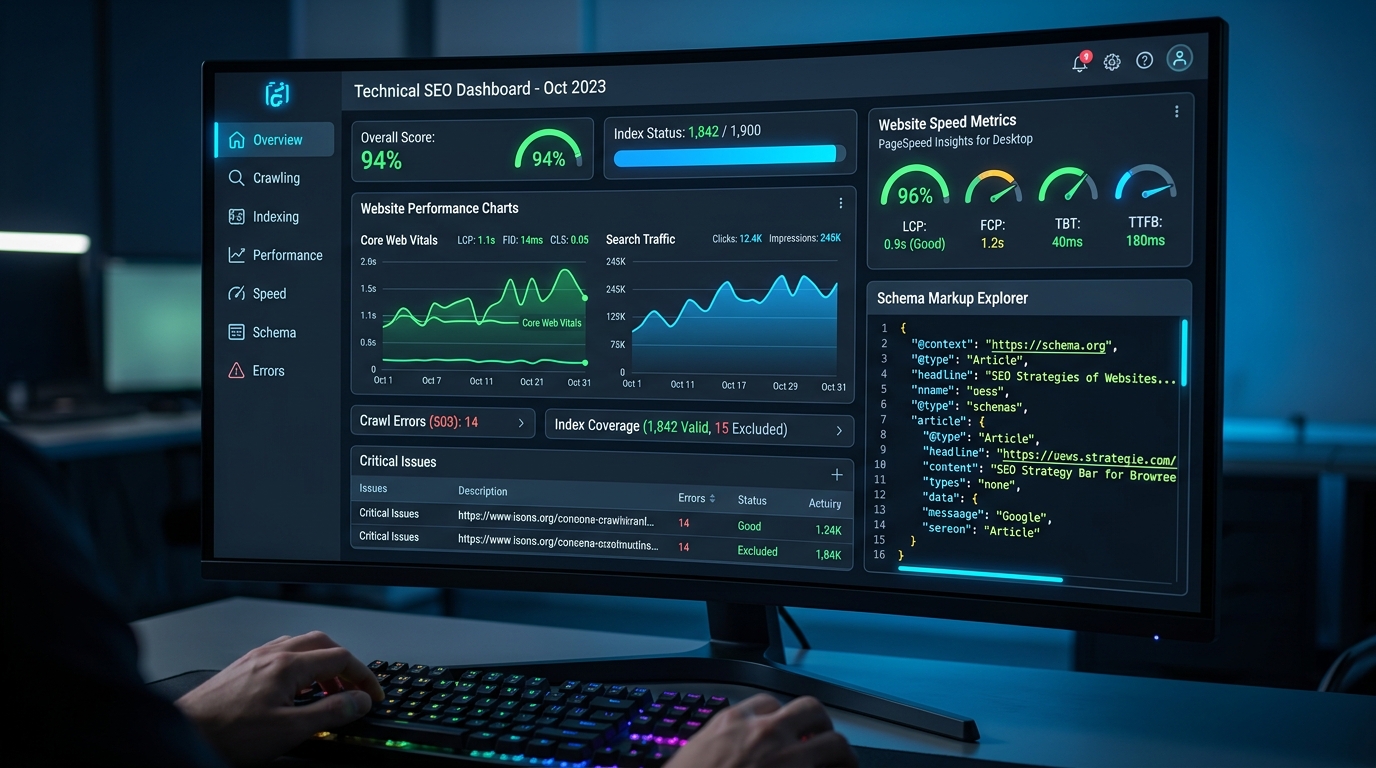

1. Introduction: The Evolution of Technical SEO in 2026
Technical SEO forms the underlying foundation of digital visibility. In 2026, search engines like Google and Bing, alongside AI discovery assistants such as ChatGPT, Perplexity, and Claude, demand instantaneous server responses, structured entity data, and flawless mobile experiences. Even the highest quality content will fail to achieve top search engine rankings if search crawlers encounter rendering bottlenecks, indexing blocks, or slow response times.
Unlike traditional content marketing, modern technical SEO requires deep alignment with front-end engineering frameworks. Integrating advanced technical SEO optimization allows developers to optimize every line of HTML markup, server routing table, and JSON-LD schema to ensure maximum search bot indexability and lightning-fast user experience.
2. Static HTML Pre-Rendering vs. Client-Side Rendering (CSR)
Single Page Applications (SPAs) built with traditional client-side React often serve an empty HTML container <div id="root"></div> that relies entirely on browser JavaScript execution. While human users with fast devices eventually view the rendered page, search crawlers frequently defer JavaScript processing, resulting in delayed indexing or complete omission from search results.
Implementing Next.js static site generation (SSG) pre-compiles every single landing page and blog route into pure static HTML during build execution. Crawlers receive fully populated DOM nodes, meta tags, and structured data on the first HTTP response byte. Implementing this static architecture within custom website design and development ensures rapid content indexation across global CDN networks.
Key Advantages of Static HTML Pre-Rendering
- Instant Search Indexation: Crawlers read fully rendered page text without waiting for JavaScript bundle execution.
- Sub-Second First Contentful Paint (FCP): Users receive pre-compiled HTML instantly from edge CDN nodes worldwide.
- Zero Server CPU Overhead: Pre-rendered static assets reduce database queries and server load during high traffic spikes.
- Enhanced Security Shielding: Static export files eliminate database injection risks and dynamic server vulnerabilities.
3. Core Web Vitals & Real User Experience (RUX) Tuning
Google evaluates site performance through three primary Core Web Vitals metrics, which directly impact search engine ranking position (SERP):
- Largest Contentful Paint (LCP): Measures perceived loading speed by timing when the main hero element or image is rendered on screen. Target threshold: < 2.5 seconds.
- Interaction to Next Paint (INP): Assesses page responsiveness by measuring the delay between user interaction (clicks, taps, keystrokes) and visual UI updates. Target threshold: < 200 milliseconds.
- Cumulative Layout Shift (CLS): Quantifies visual stability by measuring unexpected layout shifts during page loading. Target threshold: < 0.1.
Achieving 95+ PageSpeed performance scores requires eliminating render-blocking CSS/JS, hosting fonts locally, compressing images into modern WebP/AVIF formats, and executing modular code splitting. Modern web applications built on performance-first frameworks deliver peak Core Web Vitals out of the box.
Canonicalization & Trailing Slash Standardization
Duplicate content issues frequently penalize websites accessible via multiple URL variations (e.g., https://domain.com/blog/seo vs https://domain.com/blog/seo/). Enforcing strict 301 redirects to a single URL format and embedding matching canonical meta tags prevents split page authority.
4. Structured JSON-LD Schema Architecture
Structured data communicates explicit semantic meaning to search engines using standardized schema definitions from Schema.org. Embedded via JSON-LD script blocks, schemas power rich search snippets, knowledge graphs, and AI answers.
Key schemas every modern website must implement include:
- Organization Schema: Established on the home page to define corporate logos, social profiles, contact details, and brand identity.
- WebPage Schema: Embedded on main pages detailing site architecture, category structures, and publisher attribution.
- Article Schema: Attached to blog posts defining author profiles, headline titles, publication timestamps, and featured images.
- FAQ Schema: Displays interactive Q&A dropdowns directly on Search Engine Result Pages (SERPs) to increase click-through rates (CTR).
- Breadcrumb Schema: Outlines navigational hierarchy for crawlers and human visitors across site routes.
For complex enterprise applications requiring structured data modeling, custom web application development provides modular API structures and secure database schemas.
5. Robots.txt, XML Sitemaps & AI Search Bot Access
An optimized robots.txt file guides search crawlers toward critical pages while preserving server crawl budget. As AI search engines like ChatGPT (GPTBot), Claude (ClaudeBot), and Perplexity (PerplexityBot) become primary search tools, explicitly allowing these crawlers ensures your site appears in AI-generated answers.
Furthermore, XML sitemaps must be dynamically generated, referencing only 200 OK canonical URLs with accurate lastmod timestamps. The complete route map is indexed in the official XML sitemap.
6. Comprehensive Technical SEO Audit Checklist
Follow this actionable step-by-step checklist to keep your website in top technical condition:
- ✔ Verify 100% valid XML Sitemap containing zero 404, 301, or 500 error status codes.
- ✔ Test mobile responsiveness and zero layout displacement across all smartphone screens.
- ✔ Enforce HTTPS encryption across all subdomains with HTTP-to-HTTPS 301 redirects.
- ✔ Fix broken internal links and audit anchor tags across every published article.
- ✔ Compress images to sub-100KB sizes with explicit
altdescriptive attributes. - ✔ Monitor Google Search Console weekly for index coverage errors and security flags.
7. Summary: Partnering with Technical SEO Engineers
Executing a thorough technical SEO overhaul requires deep collaboration between software developers and search strategists. If your business is experiencing stagnant organic traffic, slow load times, or indexation errors, addressing technical code debt is essential.
Exploring real-world case studies across web development case studies or scheduling a web development consultation accelerates digital growth.